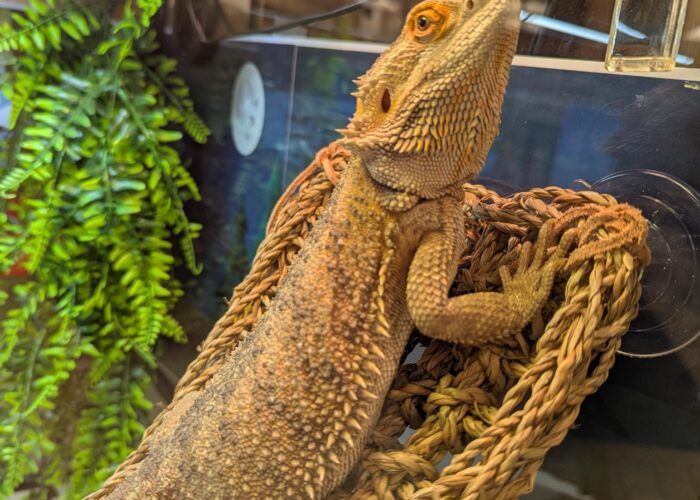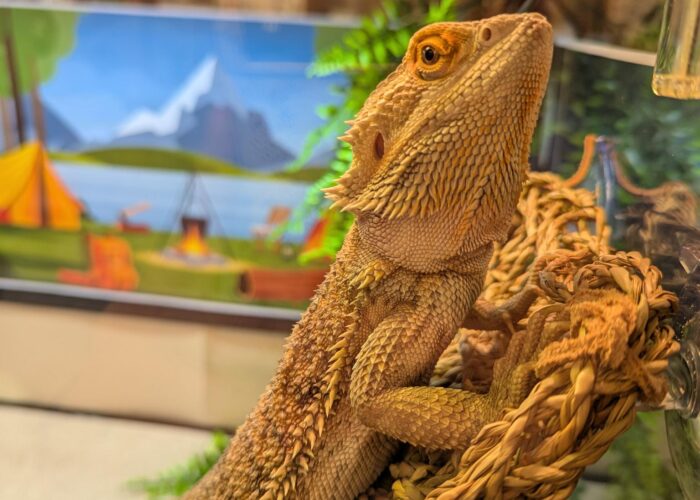
 Our bearded dragon Animal Ambassador, Clementine, was donated to us from a local army family that was moving. Youth Services Librarian, Lizzie Brazelton, housed her until Loki left us in September of 2025. Her first day at the library was September 15, 2025, and she has settled in well to her new home.
Our Animal Ambassador care is sponsored by the Friends of the Library, and we are incredibly grateful for all they do for us.
Loki was rescued through Archie’s Angels, based in Green Bay. When our beardie arrived at Archie’s Angels, he had a respiratory infection and Metabolic Bone Disease (MBD). He overcame his respiratory infection, though it left him with scar tissue that sometimes causes him to make a raspy croaking sound when he breathes. His MBD, on the other hand, will always be with him. It causes his mouth to hang open sometimes, giving the rather sweet illusion that he is smiling. He loves to eat. He has salad every day, and his favorite proteins are live crickets and roaches. While we don’t know exactly how old he is, a veterinarian estimates he is about 3 or 4 years old.
The bearded dragon is native to Australia. They live in woodlands, savannahs, and deserts. They are semiarboreal, meaning they spend some of their time in trees and some on the ground. You can find them basking in branches, on stumps, or on rocks. Bearded dragons were first brought to the United States in the 1990s and have since become popular pets.
 The bearded dragon’s scientific name is Pogona Vitticeps. They are sometimes called Beardies for short.
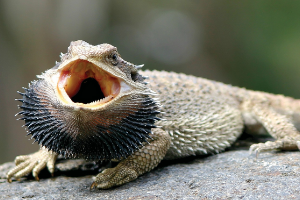
Bearded dragons have spikes and scales around their head that look like a beard when puffed out. When they feel threatened or excited, they puff out their “beard,” flatten their belly, and open their mouth to make themselves look bigger.
Bearded dragons make great pets! They are easy-going and relaxed. They are one of the most popular pet lizards in the world. Bearded dragons enjoy being handled and pet. They can walk on a leash and will even let you dress them in clothing. Beardies can recognize their owners and show love. They communicate by bobbing their head, waving, or changing color.
Bearded dragons can live 10-12 years if they are well taken care of.
 Bearded dragons are medium-sized lizards that can grow from 12-14 inches long from head to tail. Their tail is approximately half the length of their body.
Baby beardies are very small when freshly hatched—typically only three or four inches and only weigh two grams—as much as five paperclips.
Male bearded dragons have a wider head and darker beard than that of the female. Females have a thinner and longer tail in contrast to males. The most accurate way to determine your bearded dragon’s sex is by looking at its underside to see if you can recognize any gender-specific body parts.
 Bearded dragons are omnivores—they eat fruits, vegetables, and insects. They get most of their water from the plants and vegetables they eat, soaking in water, and from misting.
 Bearded dragons are diurnal—they are awake during the day and sleep at night.